報名截止日:2012年10月16日
主辦單位:法鼓佛教學院學術出版組
會議主旨
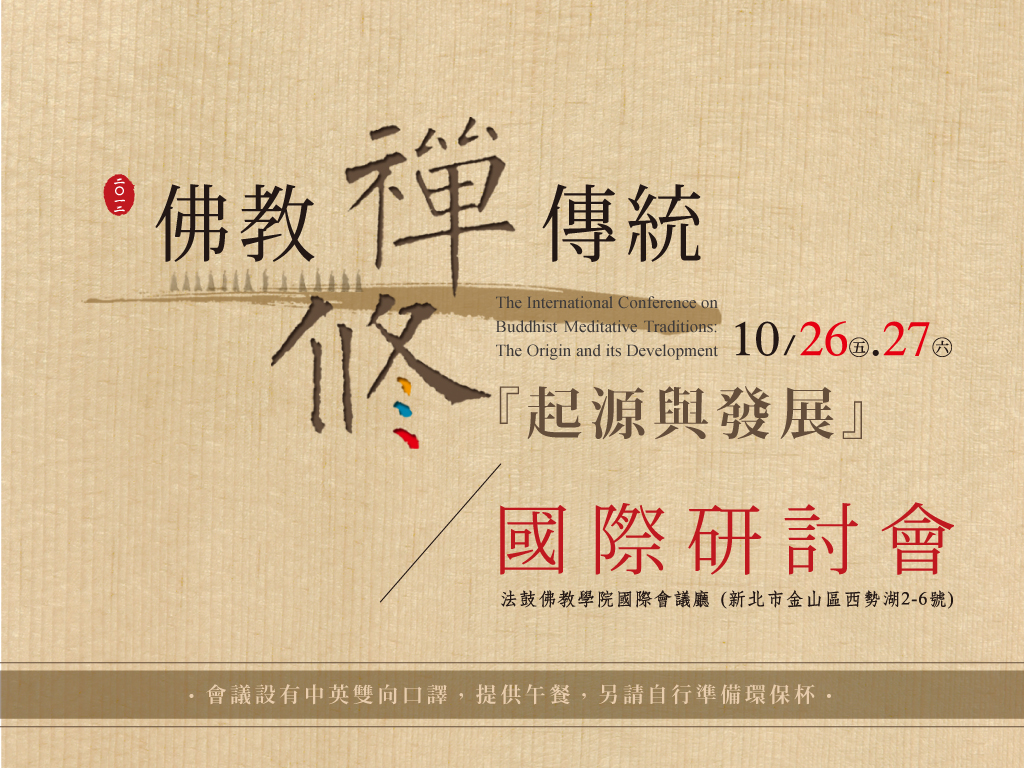
約2500年前,佛教起源於印度,其發展與傳播有三個時期:初期之南傳(斯里蘭卡、緬甸、泰國、寮國等地)的聲聞乘佛教、中期之北傳(中國、韓國、日本、越南等地)的菩薩乘佛教、及後期之藏傳(西藏、蒙古等地)金剛乘佛教。也是流傳至今佛教三大禪修傳統的歷史淵源。 從早期佛教的《阿含經》,到部派、大乘佛教的諸論,乃至現代各傳承的禪師著作、開示,禪修這一課題隨著佛教的發展而不斷地開花結果,呈現出各式各樣的禪修理論與實踐方式。本次研討會的主題就是圍繞著佛教禪修,不論是從起源,或是其發展來討論。
此一系列國際研討會規劃如下:
- 2012及2013年以「佛教禪修傳統」為主題:
- 2012年以「起源與發展」為研討重點。
- 2013年以「比較與對話」為研討重點。
- 2014及2015年以「佛教禪修傳統與現代社會」為主題:
- 2014年以「研究理論、方法」為研討重點。
- 2015年以「意義與實踐」為研討重點。
與會學者
| 姓名 | 國籍 | 所屬單位 | 題目 |
| Bart Dessein | 比利時 | 根特大學 | The ‘Spheres of Mastery’ (abhibhvāyatana) and their Relation to the Four Dhyānas (meditative stages) in the Sarvāstivādin Path to Liberation |
| Anālayo | 德國 | 漢堡大學 | Perspectives on the Body in Early Buddhist Meditation |
| Cathy Cantwell | 英國 | Oxford University | Development of a Tantric Meditation Practice: Three Generations of Tibetan Lamas |
| Alberto Todeschini | 美國 | Mangalam Research Center for Buddhist Languages | Appeals to Meditative States in the Context of Legitimation in Asaṅga’s Summary of the Great Vehicle (Mahāyānasaṃgraha) |
| 山部能宜 Nobuyoshi Yamabe |
日本 | 東京農業大學 | Yogācāra Influence on the Northern School of Chan Buddhism |
| 石田智宏 | 日本 | 立正大學 | Changing Interpretations of What Meditation Signifies in the Bodhicaryāvatāra |
| 蔡耀明 | 台灣 | 台灣大學 |
八解脫之解脫學理的探究 (Inquiry into the Reasoning of Liberation of the “Eight Levels of Liberation”) |
| 宗玉媺 | 台灣 | 佛光大學 | 瑜伽派經典中的涅槃與真如:菩薩道對聲聞道的模擬 |
| 劉國威 | 台灣 | 佛光大學 | 西藏佛教噶舉派大印(Mahāmūdra)禪修傳統之分析—以「俱生和合」為基礎 |
| 釋果暉 | 台灣 | 法鼓佛教學院 | 新發現安世高譯《十二門經》寫本內容探討及其在漢傳禪佛教中之運用 |
| 蔡伯郎 | 台灣 | 法鼓佛教學院 | 瑜伽行派的止觀 |
| 廖本聖 | 台灣 | 法鼓佛教學院 | 禪定相關術語的考察 |
| 鄧偉仁 | 台灣 | 法鼓佛教學院 | Perception, Meditation, and Reality: A Phenomenological Reflection |
| 竺樂安 | 義大利 | 法鼓佛教學院 | The soteriological function of the appamāṇas/apramāṇas in the early Buddhist path to liberation |
會議議程表
| 10 月 26 日(星期五) | |
| 時間 | 議程 |
| 08:30 ~ 08:45 | 報到、領取會議資料 |
| 08:45 ~ 09:00 | 開幕式 |
| 09:00 ~ 10:30 |
第一場次 主持人:鄧偉仁 Anālayo: Perspectives on the Body in Early Buddhist Meditation Dhammadinna: The soteriological function of the appamāṇas/apramāṇas in the early Buddhist path to liberation Bart Dessein: The ‘Spheres of Mastery’ (abhibhvāyatana) and their Relation to the Four Dhyānas (meditative stages) in the Sarvāstivādin Path to Liberatio |
| 10:30 ~ 10:50 | 茶敘 |
| 10:50 ~ 11:50 |
第二場次 主持人:梅靜軒 Cathy Cantwell: Development of a Tantric Meditation Practice: Three Generations of Tibetan Lamas 劉國威: 西藏佛教噶舉派大印(Mahāmūdra)禪修傳統之分析—以「俱生和合」為基礎 |
| 11:50 ~ 13:40 | 午餐 |
| 13:40 ~ 15:10 |
第三場次 主持人:劉國威 石田智宏: Changing Interpretations of What Meditation Signifies in the Bodhicaryāvatāra 宗玉媺: Nirvāṇa and Tathatā in the Yogācāra Texts: The Bodhisattva’s Adaptation of the Śrāvaka-path Alberto Todeschini: Appeals to Meditative States in the Context of Legitimation in Asaṅga’s Summary of the Great Vehicle (Mahāyānasaṃgraha) |
| 15:10 ~ 15:30 | 茶敘 |
| 15:30 ~ 17:00 |
第四場次 主持人:宗玉媺 蔡伯郎: 瑜伽行派的止觀 山部能宜: Yogācāra Influence on the Northern School of Chan Buddhism 釋果暉: 新發現安世高譯《十二門經》寫本內容探討及其在漢傳禪佛教中之運用 |
論文摘要
- Bart Dessein: "The ‘Spheres of Mastery’ (abhibhvāyatana) and their Relation to the Four Dhyānas (meditative stages) in the Sarvāstivādin Path to Liberation" [abstract]
- Anālayo: "Perspectives on the Body in Early Buddhist Meditation" [abstract]
- Cathy Cantwell: "Development of a Tantric Meditation Practice: Three Generations of Tibetan Lamas" [abstract]
- Alberto Todeschini: "Appeals to Meditative States in the Context of Legitimation in Asaṅga’s Summary of the Great Vehicle (Mahāyānasaṃgraha)" [abstract]
- 山部能宜: "Yogācāra Influence on the Northern School of Chan Buddhism" [abstract]
- 石田智宏: "Changing Interpretations of What Meditation Signifies in the Bodhicaryāvatāra" [abstract]
- 蔡耀明: "八解脫之解脫學理的探究(Inquiry into the Reasoning of Liberation of the “Eight Levels of Liberation”)" [abstract]
- 宗玉媺: "瑜伽派經典中的涅槃與真如:菩薩道對聲聞道的模擬" [abstract]
- 劉國威: "西藏佛教噶舉派大印(Mahāmūdra)禪修傳統之分析—以「俱生和合」為基礎" [abstract]
- 釋果暉: "新發現安世高譯《十二門經》寫本內容探討及其在漢傳禪佛教中之運用" [abstract]
- 蔡伯郎: "瑜伽行派的止觀" [abstract]
- 廖本聖: "禪定相關術語的考察" [abstract]
- 鄧偉仁: "Perception, Meditation, and Reality: A Phenomenological Reflection" [abstract]
- 竺樂安: "The soteriological function of the appamāṇas/apramāṇas in the early Buddhist path to liberation" [abstract]
The ‘Spheres of Mastery’ (abhibhvāyatana) and their Relation to the Four Dhyānas (meditative stages) in the Sarvāstivādin Path to Liberation
Bart DesseinGhent University
bart.dessein@UGent.be
The ‘spheres of mastery’ (abhibhvāyatana) form one group of a series of elements (dharma) that are developed by the practitioner when, on the path to liberation, applying meditative attainment: four immeasurable sentiments (apramāņa), eight liberations (vimokşa), eight spheres of mastery (abhibhāyatana), and ten generalising spheres (kŗtsnāyatana). The Sarvāstivāda treatises explain that these groups are connected to specific forms of knowledge that annihilate specific forms of defilement, and lead to mastery of meditative attainment. They thus show that in Sarvāstivāda doctrine, knowledge and concentration are cooperative means to, finally, overcome all defilements and attain Nirvāņa. This paper will discuss the way the ‘spheres of mastery,’ types of meditative attainment that prevent desire from arising when the practitioner who abides in a meditative stage (dhyāna) considers the six sense-fields (āyatana), were presented in the early Sutra literature, and how, through their inclusion in the early Ṣaṭpādābhidharma texts Saṃgītiparyāya (T.1536) and Prakaraņapāda (T.1542), became integrated in the Sarvāstivādin path to liberation as a specific practice done in the meditative stages (dhyāna) of the realm of form (rūpadhātu), and connecting meditative attainment with the process of overcoming defilements. This development will be discussed through an analysis of Dharmaśreşṭhin’s *Abhidharmahŗdaya, and of the Sarvāstivāda doctrinal texts that postdate the latter text.
Back To Top
"The Body in Early Buddhist Meditation"
My paper will explore different perspectives on the human body in early Buddhist meditation, proceeding through three main topics:a) A negative evaluation of the notion of bodily beauty in early Buddhist meditation practice, exemplified in the contemplation of the anatomical parts of the body;
b) A neutral perspective on the body as evident in the development of mindfulness of the body in any of its postures;
c) A positive attitude towards bodily experience during progress through the meditative absorptions, where the whole body is described as filled with intense bliss and happiness.
By way of conclusion I will show that these three aspects stand in a meaningful relationship to each other.
Back To Top
Development of a Tantric Meditation Practice: Three Generations of Tibetan Lamas.
Cathy Cantwell, University of OxfordThis paper traces the development of a tantric meditation practice across three generations of Tibetan lamas considered to be linked by reincarnation. The focus is a visualisation practice on the popular tantric deity, Vajrakīlaya. Meditative traditions relating to Vajrakīlaya are ubiquitous in Tibetan sources, including root tantras, transmitted instructions, and fresh revelations. Key passages, such as the verses for the meditative build-up of the maṇḍala, are shared in many sources, but there are also variants characterising different traditions of practice. Exactly how such a tradition of practice is developed over time is explored in the works of the seventeenth century Dudul Dorje (bdud 'dul rdo rje, 1615-1672), the nineteenth century Dudjom Lingpa (bdud 'joms gling pa, 1835-1904), and the twentieth century Dudjom Jigdral Yeshe Dorje (bdud 'joms 'jigs bral ye shes rdo rje, 1904-1987). Dudjom Lingpa, who produced three sets of Vajrakīlaya ritual meditations within his larger revelatory cycles, trained in Dudul Dorje's tradition and became seen as his emanation. Dudjom Lingpa's recognised immediate incarnation, Dudjom Jigdral Yeshe Dorje Rinpoche, was one of the main lineage holders who contributed to new textual compositions for a number of different revelatory traditions, including his work on editing and advancing the revelations of his predecessor, as well as revealing new scriptures himself. Comparisons between the Vajrakīlaya productions of the three lamas show continuities giving the lineage of practice its stamp of identity, while we also witness significant re-working, elaboration, systematisation and codification of the liturgical material and meditative instructions.
Back To Top
"Appeals to Meditative States in the Context of Legitimation in Asaṅga’s Summary of the Great Vehicle (Mahāyānasaṃgraha)."
Alberto TodeschiniYogācāra Buddhism has long been associated with meditation and mentions of meditative states are widespread in its literature. The nature of such association is, however, still far from having been fully elucidated. One important Yogācāra text that contains numerous references to meditation and to particular meditative states is Asaṅga’sMahāyānasaṃgraha. Many of these references appear in the context of arguments in favor of various Yogācāra doctrines, especially of doctrines related to Asaṅga’s understanding of the mind. In the Mahāyānasaṃgraha, then, one of the main functions of meditation and meditative states is to provide backdrop for the text's rhetorical and legitimation goals.
Back To Top
Yogācāra Influence on the Northern School of Chan Buddhism
Nobuyoshi YamabeIn East Asian contexts, Yogācāra Buddhism is often seen as a theoretical system rather than a collection of practical instructions. In particular, many people seem to have the stereotypic image that the Faxiang tradition (based on the Yogācāra texts brought to China by Xuanzang) was a highly scholastic system, while Chan (Zen) Buddhism emphasized intuitive penetration into the essence of Buddhism. Thus, these two traditions are thought to have stood at the opposite ends of a spectrum. If one actually looks into early Chan texts, however, one realizes that the matter is not so simple. The Yuanming lun and Zhenzong lun, for example, clearly display traces of the strong influence of Xuanzang's Yogācāra texts. By carefully examining Northern Chan texts, I would like to demonstrate that Xuanzang's Yogācāra system exerted influence not only on theoretical aspects but also on practical (meditative) elements of Chinese Buddhism.
Back To Top
Changing Interpretations of What Meditation Signifies in the Bodhicaryāvatāra
Chiko ISHIDAOne important Mādhyamika text that deals with the subject of meditation (dhyāna) is the Bodhicaryāvatāra. This text, whose overall theme is the ten pāramitās, takes up the topic of dhyāna in the eighth chapter.
There are two extant versions of the Bodhicaryāvatāra, with many differences between the earlier version (thought to most preserve the structure of the original text) and the later, enlarged version. In the enlarged version, the chapter on dhyāna discusses not only the practice of contemplating the impurity of the body but also that of contemplating the equality of self and other. In the earlier version of the text, however, contemplation of the equality of self and other is discussed not in the chapter on dhyāna but in the chapter on virya (strength).
My presentation discusses the philosophical basis for this reorganization of chapter content in the enlarged version, as well as what effects the subsequent acceptance of the enlarged version as the standard text had upon Mahāyāna Buddhism, particularly in Tibet. I also examine the expression of these philosophical developments in various commentaries on the Bodhicaryāvatāra.
Back To Top
尚無摘要
Back To Top
Nirvāṇa and Tathatā in the Yogācāra Texts:The Bodhisattva’s Adaptation of the Śrāvaka-Path
瑜伽派經典中的涅槃與真如:菩薩道對聲聞道的模擬
摘要菩薩道擁有如聲聞道般的修行與果位的階次,故中、印釋論家都主張菩薩道有所謂的見道位。這導致許多學者將菩薩的無分別智等同於聲聞乘無為的經驗。但這與《般若經》及早期大乘經典都勸勵菩薩在修菩薩道的過程中不可證無為──涅槃的說法相違,因為菩薩若證無為或涅槃,便須離開世間,不能留在世間累集無數劫的功德以成佛。
《瑜伽師地論》許多地方,尤其〈菩薩地〉中即繼承菩薩不可證無為的觀念。菩薩不以無為為目的,也不斷所有的煩惱。但是在〈菩薩地〉也同時提到菩薩從初地開始便能以願力轉生,並且在八地時能以無分別智進入真如。有學者認為以願力轉生便是非以業力轉生。這導致一些學者把真如看作是無為的境界。但是這與菩薩不斷煩惱,不證無為的說法相違背。那麼,這裏真如的屬性究竟是什麼?
而在《瑜伽師地論》裏,〈聲聞地〉則收集了許多有關聲聞道的看法。因此,從〈菩薩地〉和〈聲聞地〉,讓瑜伽行系統可較方便的比較聲聞道與菩薩道的關係。本文即在此基礎上探究大乘的真如是否具有超越世間涅槃的特質,或是一種還未到涅槃的屬於世間的智慧。
關鍵詞:菩薩道 真如 無為 斷 世間道Abstract
Indian and Chinese commentaries on the Bodhisattva-path assign to it a path of seeing analogous to that of the Śrāvaka-path. Consequently, the non-discursive insight of the bodhisattva is usually taken to be equivalent to the insight of the śrāvaka when s/he experiences the unconditioned. Yet a matter of concern for the bodhisattva in the Prajñāpāramitā literatures and many other earlier Mahāyāna texts is that s/he should not realize the unconditioned (= nirvāṇa) in the practice of the path before s/he attains Buddhahood. Because the bodhisattva has to accumulate immeasurable kalpas of merits in order to attain Buddhahood, s/he does not want to end the circle of existence by realizing the unconditioned. Ending the circle of existence would deprive her/him of the chance to attain Buddhahood. An early extant system of the Bodhisattva-path delineated in the Yogācārabhūmi (YBh), especially in the Bodhisattvabhūmi (BoBh) follows these early Mahāyāna sūtras in the treatment of the unconditioned.
However, according to BoBh, the bodhisattva beginning from the first level can take rebirths at will and at the eighth level s/he enters into Suchness (tathatā) with non-discursive knowledge (nirvikalpajñāna). On the other hand, the bodhisattva has no esteem for the unconditioned and abstains from the abandonment of all defilements and the realization of nirvāṇa. By comparing the Bodhisattva-path in BoBh with the Śrāvaka-path delineated especially in the Śrāvakabhūmi (SrBh) of the same YBh system this paper tests whether the insight of the bodhisattva or the insight of Suchness is endowed with properties equivalent to the transcendental status of nirvāṇa or whether the insight of Suchness is a mundane insight, which still falls short of nirvāṇa.
Keywords: Bodhisattva-path Suchness Unconditioned Abandonment mundane-path
Back To Top
尚無摘要
Back To Top
新發現安世高譯《十二門經》寫本內容探討及其在漢傳禪佛教中之運用
釋果暉SHI, Guohuei
1996年於荷蘭萊茵登(Leiden)舉辦了第一屆安世高國際學術會議;1999年
在日本大阪發現了三部失傳千年以上的安世高手寫經。自此,安世高研究遂成
為國際佛學研究中的重要主題。一般將安世高所譯的禪經歸類為小乘禪經,但
本論文將提出不一樣的看法。論文中,筆者將探討新發現的《佛說十二門經》
及《佛說解十二門經》在佛教修行裡所具備的意義與價值,及其在漢傳禪佛教
中的運用。此外,並針對義大利學者Stefano Zacchetti所提出的文本結構,提
出批判:即Zacchetti所主張「增加〈十二門經註解〉為第三大部份的假說」
是沒有必要的。依筆者看,應當保留原來《佛說十二門經》及《佛說解十二門
經》兩大部份即可,而所謂的〈十二門經註解〉,應被視為《佛說解十二門
經》內容的一部份。此外,本稿也論述:文本中的四禪內容因來自安般禪法,
故其定義與傳統四禪的定義不同。尤其文本中以四念處取代四禪的說法,對漢
傳禪佛教有重要的啟發。四而四無量心則與大乘禪觀有密切的關係。
關鍵語: 安世高、四禪、四無量心、四念處、默照禪
關鍵語: 安世高、四禪、四無量心、四念處、默照禪
Back To Top
尚無摘要
Back To Top
禪定相關術語的考察
「禪定」這個術語,有時候簡稱為「定」,從CBETA的檢索來看,是用得相當廣泛的一個術語,但卻也是概念最模糊的術語之一。其中,若僅考慮T1~T32(大正新脩大藏經第一冊至第三十二冊的印度撰述部)這個範圍,「禪定」出現的次數高達4556次,而「定」出現的次數更高達73853次;但是從後者出現的語境或脈絡來看,有些是指「決定」、「固定」、「確定」,而非專指「禪定」之意,因此實際次數應該不到73853次,但其出現頻率仍然相當高而不容忽視。
「禪定」或「定」以外的「九住心」、「三昧」、「三摩地」、「等持」、「等引」、「三摩呬多」、「根本定」、「等至」、「三摩鉢底」、「禪那」、「靜慮」、「止」、「觀」、「止觀雙運」等等術語,它們的意義雖然比「禪定」來得明確,但在漢譯的三藏當中,有些譯者卻籠統地以「禪定」或甚至「定」來翻譯它們,這種情況不僅會使這些術語混淆不清,加上某些譯者習慣保留梵音而採音譯,另外的譯者則習慣意譯,也會增加讀者在理解上的難度。
因此,本篇論文打算以「禪定」這個術語作為其他相關術語的總稱,並以之為基礎,進一步探討這些術語的梵文、藏文、出處、意義、彼此關係、產生的先後次第等等。此外,也希望區分世間定與出世間定的差別、修這些禪定必須具備那些條件?能夠修這些定的認知(心與心所)有哪些?並且試圖釐清有關禪定的一些誤解。
關鍵字:1. 禪定相關術語,2. 禪定,3. 定,4. 世間定,5. 出世間定
Back To Top
Perception, Meditation, and Reality: A Phenomenological Reflection
認知、禪修與實相:現象學反思
Modes of Perception and Phenomenology in Theravada Abhidhamma
This article attempts a “phenomenological reflection” on various modes of Buddhist perception elaborated in the Pāli Abhidhamma literature, primarily the Visuddhimagga. By “phenomenological” I intend an approach relating to the central concern of Husserlian phenomenology, i.e., crudely put, the ways we perceived things or things as they experienced from the subjective point of view. Although phenomenological study of Buddhism has been dealt with, there has not been a typological systematic distinction between various dimensions of Buddhist perception for the phenomenological investigation.
Accordingly, in this article I tried to answer questions such as: How a sense object is perceived differently in different modes of perception? What is the nature of the perceived content of the various modes of perception in relation to “intentionality” and to reality? I classified Buddhist perception into three dimensions, namely, the perception of the ordinary people, the perception occurred in the concentration state (samādhi) of mind, and the insight (vipassanā) perception, that is, “seeing things as they really are (yathābhūtañānadassana).” Further, I explained the mechanism of each modes of perception and show how each of them signifies a very distinct phenomenological implication. With this undertaking, I hope to put forward a reflection as a caveat in the often over-generalized comparison of Buddhist theory of perception to the philosophical phenomenology in the West.
Back To Top
The soteriological function of the appamāṇas/apramāṇas in the early Buddhist path to liberation
Dhammadinna (PhD)Dharma Drum Buddhist College, Taiwan
giulianamartini@gmail.com
With this paper I review distinctive aspects of the early Buddhist practice of the appamāṇas/apramāṇas, the immeasurable or boundless states of benevolence, compassion, sympathetic joy and equa¬nimity. My concern is specifically the function and potential of the immeasurables in relation to the unfolding of the spiritual path of the individual. Quite apart from their beneficial relational and social effects, how are they meant to support the path to liberation?
I take as a point of reference for my presentation an early Buddhist discourse that has been preserved in parallel versions stemming from the Theravāda, Sarvāstivāda and Mūlasarvāstivāda reciter traditions, respectively the Sañcetanika-suttas and Karajakāya-sutta in the Aṅguttara-nikāya, the 思經 in the Madhyama-āgama, and a discourse quotation in the Abhidharmakośopāyikā-ṭīkā.
The sequence of instructions delivered in the discourse(s) stipulates an important correlation between training in clear comprehension and purification of intentions through the gradual path and the appamāṇa/apramāṇa practice of a noble disciple. Thus a close reading of this sequence in the context of other relevant early Buddhist texts indi¬cates that the soteriological characteristics of these meditative exercises are:
1. their relationship to the gradual path and to the dimensions of ethical purification, intentionality and karma and thereby their potential to contribute especially to progress from stream-entry to the higher levels of the path,
3. the need to develop them in conjunction with the factors of awakening (bo¬jjhaṅgas/bodhyaṅgas),
4. the use of this practice as a platform for insight (vipassanā/vipaśyanā) and thereby for the realisation of awakening.
Back To Top
線上報名
線上報名已截止。
線上報名成功
感謝您的報名。
報名失敗
若您無法報名成功,請將報名資料email至 lopeishin@ddbc.edu.tw
或來電(02) 2498-0707分機2248,會有專人為您處理,謝謝。